Why the Finish Is the Whole Job on Ornamental Iron in South Texas
Steel starts rusting fast in South Texas; the coating is what actually protects the craftsmanship underneath.
September 2, 2026 · 3 min read
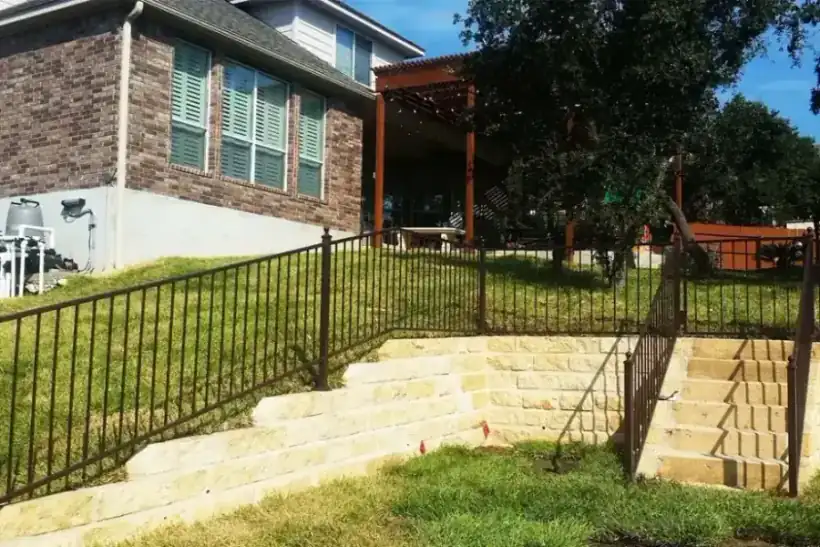
An ornamental iron fence is steel first. Left bare, it starts rusting within days in South Texas humidity, and every hour of scrollwork and welding underneath a bad finish is wasted the first summer the coating fails. The metalwork is the part everyone notices first; the finish is the part that decides whether there's still metalwork worth noticing five years on.
What electrostatic painting actually does
Electrostatic painting is the process Aztec Fence & Ornamental Iron uses to coat the ironwork it fabricates, and the mechanism is worth understanding because it explains why the result holds up better than a can of spray paint. The piece is cleaned and primed first, then charged paint particles are sprayed and drawn electrically to the grounded metal surface, which pulls the coating into every scroll, weld seam and tight corner instead of just the flat, easy-to-reach faces. That's the part a hand-sprayed or brushed finish can't match: coverage that follows the shape of the ironwork rather than the angle of the spray gun.
Why even coverage matters more on scrollwork than on a flat panel
A flat wrought iron panel is forgiving to paint. A scrolled grapevine gate or a fleur-de-lis fence line is not, because every curve creates a spot where paint can run thin, pool, or miss entirely if it's applied by hand. Thin coverage is where rust starts first, usually inside a scroll or behind a weld where nobody's looking until the color starts to bubble. Even coating isn't a cosmetic upgrade on ornamental work, it's the difference between a finish that protects the whole piece and one that protects most of it.
What South Texas humidity and sun actually do to a coating
San Antonio isn't coastal, but it's close enough to the Gulf that humidity and salt air become a real factor toward Corpus Christi and along the coastal end of Aztec's service area, and UV from long, intense summers breaks down weaker coatings from the outside in. A consistent, well-adhered finish resists both better than a thinner or unevenly applied one, because a coating that's already thin in spots from uneven application has less material left to lose before bare metal shows through.
Prep matters as much as the paint
Electrostatic painting only works as well as the prep underneath it. Surface cleaning strips mill scale, weld slag and any oxidation that's already started before the piece ever sees primer, and priming gives the topcoat something to actually bond to instead of bare, inconsistent steel. Skipping or rushing either step undercuts the whole advantage of an electrostatic finish, because charged paint particles still need a clean, properly prepared surface to adhere to evenly. The process Aztec runs, cleaning, priming, spraying, coating and drying, treats each step as load-bearing for the one after it, not as a checklist to get through.
Why this matters more on custom work than on stock panels
A stock chain-link run doesn't ask much of its finish; galvanizing does most of the protective work before paint is even a factor. Custom wrought iron is different, because the finish is often the only barrier between bare steel and the weather once the fabrication is done. That's true on a simple perimeter fence and even more true on something like a hand-scrolled gate, where every curve and weld the fabricator spent hours shaping is exactly the surface a rushed or uneven finish would fail first.
The advantages that show up years later, not just on install day
- Reduced waste, because electrostatic charging pulls more of the paint onto the piece instead of overspray drifting past it
- Lower solvent use compared with conventional spray methods
- Better adhesion, which is what actually resists chipping and peeling over time
- A uniform, consistent finish across a whole gate or fence run, not just the parts that were easy to reach
None of that shows up in a photo taken the day the fence goes up. It shows up five summers later, when a properly finished gate still looks like it was painted last year and a poorly finished one is already showing rust at the welds. Aztec Fence & Ornamental Iron builds the ironwork and finishes it in the same shop, so the scrollwork and the coating are treated as one job instead of two.
Aztec Fence & Ornamental Iron — (210) 433-8932
Call (210) 433-8932More articles
Wrought Iron, Wood or Chain-Link: Choosing a Fence Material in San Antonio
The ground under a San Antonio property usually settles the material question before style ever gets a vote.
What Actually Goes Into a Custom Gate
A custom gate starts as a conversation about the property, long before anyone touches steel.