Fence Lines
Wrought Iron Fencing
Perimeter runs, garden fence, gates and railings, drawn and welded to fit the property in front of us, not a stock panel width.
Every run is drawn to the lot, not cut to a standard panel
A wrought iron order at Aztec starts with the property, not a catalogue page. We walk the line, note where the grade rises and falls, and design panels that follow it instead of stair-stepping over it in identical sections. Commercial perimeter jobs get the same treatment as a single garden fence around a courtyard: the layout is worked out first, then fabricated. That is the difference between a fence that was installed and a fence that was made for the address it stands at. San Antonio's soil is part of the design problem. Expansive clay heaves posts a few degrees a year, and caliche and limestone under a lot of neighborhoods make a clean post hole its own small project before any iron goes in. We set footings to answer to that ground rather than assuming a standard depth will hold. It is one reason a wrought iron fence from this shop tends to still be plumb a decade later instead of leaning at the gate.
Why owners choose iron over wood or chain-link here
Customers ask for wrought iron for a short, consistent list of reasons: it holds a custom design instead of a stock shape, it does not rot the way a wood picket does under a Texas summer, upkeep is low once it is coated properly, and a welded panel is a harder target than a wood one for anybody trying to get through it. It also reads differently on a property than a chain-link run does, which matters on a street where the fence is visible from the road every day. None of that makes it the right call for every yard. A chain-link enclosure is still the honest answer for a dog run, and a cedar privacy fence still wins where the goal is blocking sightlines rather than showing a design. We will tell you which one fits before we quote either.
Certified welders and fabricators, over 200 years of combined crew experience, and construction specialty certification. Call (210) 433-8932.
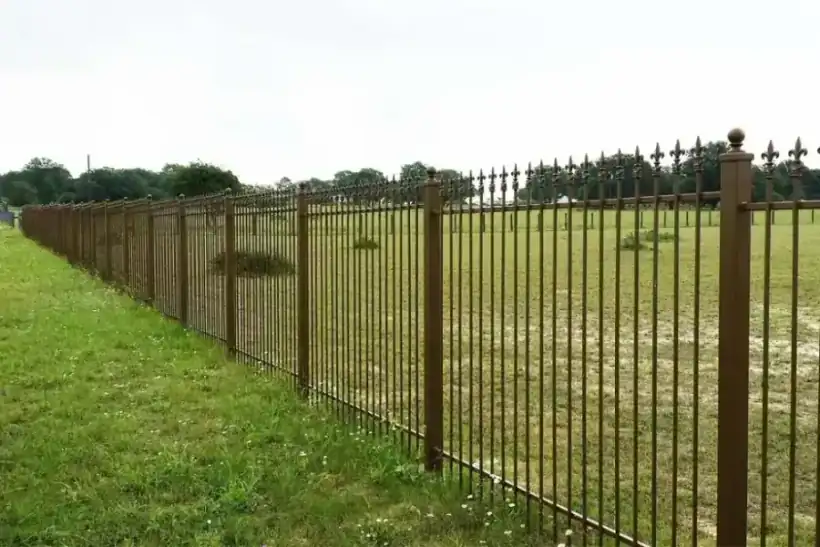
Where a garden fence and a perimeter run overlap, and where they split
A residential garden fence and a commercial perimeter run come off the same drawings and the same welding tables, but they are not the same job. A garden fence usually has to look good from six feet away, up close by a front door or a patio, so the scrollwork and panel spacing carry more weight. A perimeter run around a lot has to hold a straight, consistent line for a hundred yards or more and answer to setback and visibility requirements a homeowner never thinks about. We design each to its own distance, not to one default panel repeated at whatever scale the property happens to be.
Railings are the third category that gets grouped in with fencing but really belongs on its own. A stair or porch railing is a safety component before it is a decorative one, and we treat the two differently, from post spacing down to code-driven baluster gaps. Our stair and handrail work covers that side of the shop.
The coating decision matters more here than the design does
San Antonio summers put real hours of direct UV on a fence coating every single year, and a poor coat shows it first at the welds, where heat already stressed the metal once during fabrication. We finish wrought iron with that in mind rather than treating the coat as a last step after the design is done. It is a smaller decision than the pattern of the scrollwork, but it is the one that decides whether the fence still looks like it did on install day five summers from now.