Metal and Masonry
Stone and steel, built to outlast the clay under them.
Load-bearing, partition and retaining walls and columns, designed and built with the drainage worked out before the first course goes down.
Stone and steel, built to outlast the clay under them
A wall that cracks in three years was never a masonry problem first. It was a drainage and foundation problem that showed up as one. Load-bearing walls carry structural loads and transfer them down to the foundation. Partition walls divide a space without carrying anything. Retaining walls hold back soil and have to be built for what that soil does when it is wet. We handle the design, the construction and the acquisition of every material, and we work out the waterproofing and the drainage before anything is laid.
Why the ground here decides more than the stone does
Bexar County clay swells and shrinks with the season, and caliche and limestone make the digging its own job. Regular inspection and maintenance for cracking or erosion is available afterwards.
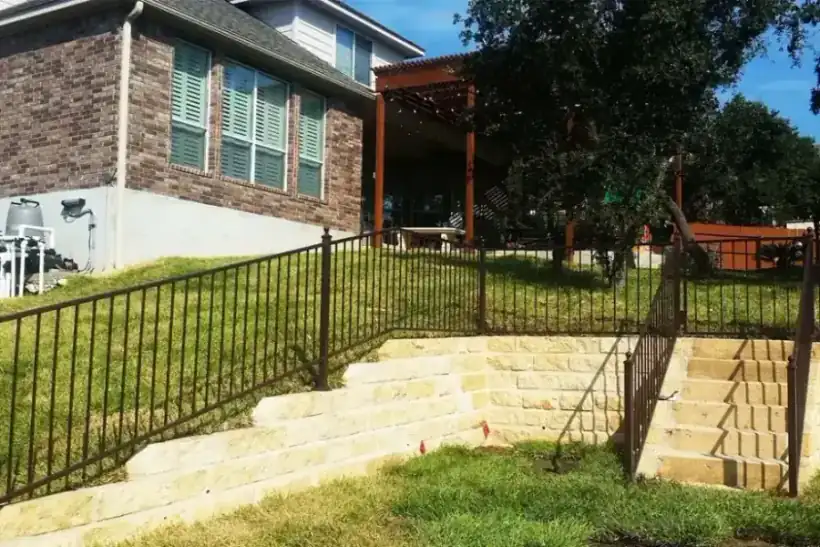
The photograph shows cut limestone courses and steps with our ironwork following them, not a wall built in isolation.
Three kinds of wall, and each one is engineered on purpose
A load-bearing wall supports structural loads and transfers them down to the foundation, which means every course of it is doing real work, not just standing there. A partition wall divides a space without carrying that load, which frees up how it can be laid out and finished. A retaining wall holds back soil, and of the three it is the one most likely to fail quietly for years before it fails visibly, because the pressure behind it never stops pushing. We design and build all three, and we acquire the materials ourselves rather than working off whatever the client happened to source, because the mason who picks the block should be the one accountable for how it performs.
San Antonio's soil is the reason we do not treat any of this as a simple stacking job. Blackland and expansive clay under a lot of this city's lots swells and shrinks with the seasons, and caliche and limestone underneath make a straightforward footing its own small engineering decision before the first block goes down. A retaining wall built without answering to that movement is a wall that will crack, and a load-bearing column built without answering to it is worse. Waterproofing and drainage get worked out as part of the design, not added after the fact, and we recommend regular inspection so a hairline crack or early erosion gets caught while it is still a cheap fix instead of a rebuild.
Over 200 years of combined experience, and it is not all in metal
The crew that fabricates a custom gate is not a separate crew from the one that builds the column it hangs on. That is deliberate. A masonry column meant to carry a heavy wrought iron gate leaf has to be engineered around the weight and swing of that specific gate, not a generic post, and it is a lot easier to get that right when the same shop is answering for both halves of the job. If your project is a masonry entrance with iron worked into it, or a custom fabrication piece that needs a wall or column to sit on, we can carry the whole thing, and our general construction crew steps in when the project extends past the masonry itself.