What Actually Goes Into a Custom Gate
A custom gate starts as a conversation about the property, long before anyone touches steel.
September 2, 2026 · 4 min read
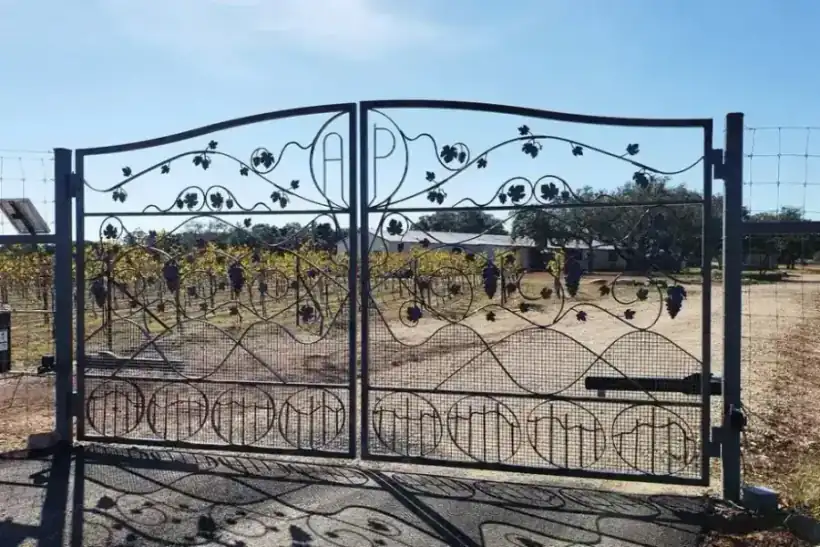
The gate that gets photographed the most out of anything Aztec Fence & Ornamental Iron has built isn't a fence line at all. It's a double driveway gate at a vineyard property, hand-scrolled grapevine and grape-cluster ironwork running across both leaves with a monogrammed roundel at the center. It didn't start as ironwork. It started as a sketch and a conversation about what the property actually needed a gate to say.
It starts with the property, not the catalog
A custom gate isn't picked off a rack, it's built to the opening, the use, and the look the property is going for. That means measuring the drive, deciding whether it swings or slides, working out clearance for vehicles, and figuring out what material carries the design best. Aztec builds gates in aluminum, steel, chain-link, vinyl, wood and wrought iron, and the material choice usually comes down to whatever the design calls for. A grapevine motif with fine scrollwork wants wrought iron, because iron can be shaped into curves and detail that wood and vinyl can't hold.
The design has to mean something to the property
The vineyard gate works because the motif isn't decoration for its own sake, it's the property's own crop rendered in metal. That's the difference between a custom gate and an expensive stock one: the ironwork references something real about the place, whether that's a family monogram, a ranch brand, a business mark, or the crop growing on the other side of the fence. Aztec's own logo comes from this same instinct, hand-drawn scrollwork that mirrors the ironwork the shop actually fabricates.
From sketch to shop floor
Once a design is settled, the work moves to the fabrication shop, where flat stock and rod get cut, shaped, scrolled and welded into the pattern drawn on paper. Custom scrollwork like the grapevine leaves is done by hand, curve by curve, not stamped out of a die. A monogram roundel like the vineyard gate's "AP" medallion gets built as its own piece and set into the frame so it reads as one continuous design instead of an add-on.
Hardware decides whether the design works every day
- Hinges rated for the gate's real weight, which iron gates carry a lot of
- Latches and locks matched to how the property is actually used, from a simple gravity latch to full access control
- Automation for a gate that needs to open without anyone getting out of the car
- Decorative elements integrated into the frame rather than bolted on afterward
A beautiful gate that binds on its hinges or won't hold a latch in the wind isn't finished, it's unfinished with good photos. This is the stage where a lot of custom gates get rushed, and it's the stage that decides whether the gate still swings clean in five years.
Installation and automation, if the property needs it
Gates get installed across driveway, farm and ranch, residential, security and commercial settings, and each of those settings changes what "finished" means. A residential driveway gate might just need a swing arm and a keypad. A farm gate might need to survive livestock leaning on it. A commercial or security application might call for full access control built into the operator. Aztec builds and installs gate operators alongside the gate itself, so the automation is designed in from the start rather than retrofitted onto a gate that was never built to carry it.
Maintenance built for the long run
A wrought iron gate doesn't need much upkeep once it's hung and finished, but it isn't zero-maintenance either. Hinges and latches get inspected, an automated gate's operator benefits from the seasonal winter and summer maintenance Aztec offers, and a coat check every so often keeps the finish doing its job before rust ever gets a foothold in a scroll or a weld seam. A gate built right the first time, with hardware sized to its actual weight, mostly just needs to be looked at rather than fixed.
Estimates and permits, before the sketch becomes steel
Aztec offers free estimates before any of this starts, and pulls its own building permits on projects that need them, so a custom gate doesn't stall on paperwork the way a smaller outfit's projects sometimes do. None of that changes what the design and fabrication stages actually take; it just means the property owner isn't the one chasing the permit office while the gate sits half-built on the shop floor.
The vineyard gate took a sketch, a monogram, hand-scrolled ironwork and a lot of shop hours to become the thing people stop and photograph. That's roughly what any real custom gate takes, whatever San Antonio property it ends up guarding, and it's the kind of build Aztec Fence & Ornamental Iron has been doing since 1954.
Aztec Fence & Ornamental Iron — (210) 433-8932
Call (210) 433-8932More articles
Wrought Iron, Wood or Chain-Link: Choosing a Fence Material in San Antonio
The ground under a San Antonio property usually settles the material question before style ever gets a vote.
Barrier, Cantilever, Overhead, Sliding or Swing: Which Gate Operator Fits Your Driveway
The ground and the clearance around a driveway usually decide the operator before the budget does.