Barrier, Cantilever, Overhead, Sliding or Swing: Which Gate Operator Fits Your Driveway
The ground and the clearance around a driveway usually decide the operator before the budget does.
September 2, 2026 · 4 min read
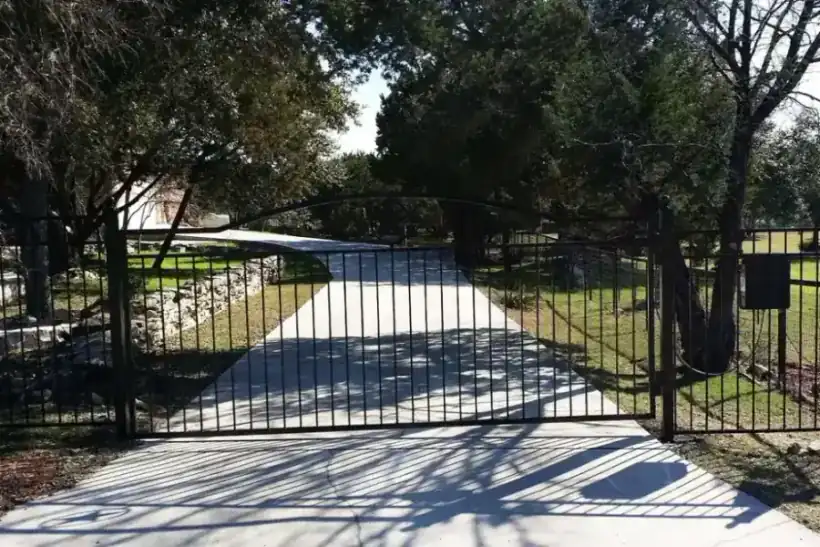
A gate operator is only as good as the ground and the gate it's asked to move. Pick the wrong type for a sloped driveway or a gate heavier than it looks, and the result is replacing motors and hardware every couple of years instead of once a decade.
Swing operators, the default for a reason
Swing operators open a gate the way a door opens, pivoting on hinges mounted to posts on either side of the drive. They suit most residential driveways and work well with wrought iron gates like the ones Aztec builds, single or double leaf. The thing that actually decides whether a swing operator is right isn't the gate, it's the clearance behind it. A gate that swings inward needs room on the property side to open fully without catching a parked car, a slope, or a curb.
Sliding operators, for tight or sloped driveways
A sliding gate runs along a track parallel to the fence line instead of swinging into the property, which makes it the answer for a driveway that's too short, too sloped, or too tight on either side to give a swing gate room to move. The tradeoff is that a slide gate needs a straight, level run of track equal to the gate's own width, so it isn't always an option on every lot.
Overhead operators, for gates that lift rather than swing
Overhead operators raise the gate vertically instead of moving it side to side, which is less common on residential fencing but useful where ground clearance and side space are both limited. It keeps the footprint small at the cost of extra structure overhead to carry the gate's weight.
Cantilever operators, when there's nowhere to put a track
A cantilever gate slides like a track gate but is counterbalanced and rolls on rollers set into the posts instead of running in a ground-level track, so there's nothing at grade to catch on debris, ice or standing water. It suits commercial and industrial sites more often than residential driveways, where the extra structural rollers and counterweight are worth it for a gate that has to keep working through weather and heavy traffic.
Barrier operators, for controlling traffic, not enclosing a property
A barrier operator isn't really a gate at all, it's an arm that raises and lowers to control vehicle access, the kind found at parking lots and gated commercial entries. It's the right call when the goal is managing who and what gets through a single lane rather than securing a full perimeter.
Matching an operator to the gate's material and weight
The operator has to match the gate, not just the driveway. A heavy wrought iron double gate needs a swing or slide operator rated for real weight, not a lighter-duty unit built for aluminum or vinyl. A long chain-link or steel security gate on a commercial site usually pairs with a slide or cantilever operator built for continuous daily cycles rather than the occasional home use a swing operator sees on a residential drive. Getting the operator size wrong for the gate's actual weight is one of the most common reasons a driveway gate stops working within its first year or two, long before the ground or the weather ever gets blamed for it.
Access control on top of the operator
Every operator type in this list can be paired with access control, and that's really a separate decision from which operator moves the gate. A single-family home might run a keypad or remote at the gate; a commercial site with tenants or delivery traffic might need something with more control than one shared code. The operator gets the gate moving, access control decides who gets to make it move. Aztec installs both together, so the two get specified as one system instead of an operator retrofit later.
Questions worth answering before picking an operator
- How much clear space sits behind or beside the gate when it's fully open
- Whether the driveway has any slope across the gate's swing or slide path
- How heavy the finished gate actually is once the design and material are set
- How many times a day the gate needs to open and close
- Whether power is already run to the gate location or needs to be added
The ground decides more than the budget does
Every one of these operators can be integrated with access control, and Aztec offers seasonal winter and summer maintenance on the systems it installs, because an operator that sits mostly unused for months at a stretch needs a check before the next season puts it back to work daily. The type that's right for a given driveway usually comes down to clearance, slope, and how the gate gets used day to day, not which one looks best in a brochure.
Aztec Fence & Ornamental Iron — (210) 433-8932
Call (210) 433-8932More articles
Wrought Iron, Wood or Chain-Link: Choosing a Fence Material in San Antonio
The ground under a San Antonio property usually settles the material question before style ever gets a vote.
What Actually Goes Into a Custom Gate
A custom gate starts as a conversation about the property, long before anyone touches steel.