Wrought Iron, Wood or Chain-Link: Choosing a Fence Material in San Antonio
The ground under a San Antonio property usually settles the material question before style ever gets a vote.
September 2, 2026 · 4 min read
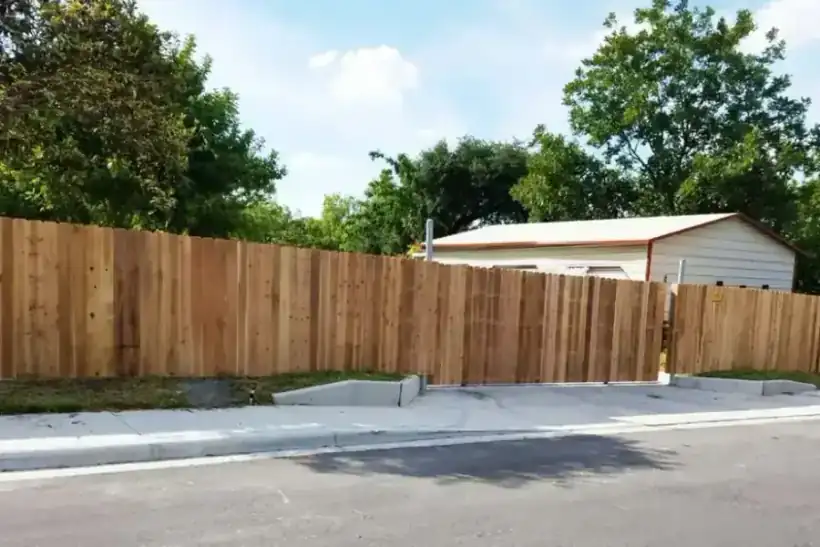
Dig a post hole in the black clay east of downtown San Antonio and you're fighting soil that swells when it rains and cracks open in August. Dig one forty minutes north into the Hill Country and you're fighting caliche, a hard limestone crust that eats auger bits for breakfast. Same city, two completely different problems, and the fence material that survives one won't necessarily survive the other.
What the soil decides before you ever pick a style
Expansive clay is the bigger long-term threat. It grips a post in wet weather and lets go in dry weather, and that cycle works a fence loose over years, not months. Concrete footings poured deep enough to get below the active zone matter more here than in most of Texas. Caliche and limestone cause a different headache: post holes that take twice as long to dig and sometimes need a hammer drill or a rented breaker instead of a hand auger. Aztec Fence & Ornamental Iron has been setting posts in both kinds of ground around San Antonio since 1954, and the footing decision gets made before anyone talks about pickets or panels.
Wrought iron: built for the long haul and the front of the house
Wrought iron earns its keep on visibility and durability. A well-built iron fence outlasts wood by decades, needs almost no upkeep beyond an occasional coat check, and reads as permanent in a way wood and chain-link don't. It works for a garden border, a full commercial perimeter, or a driveway gate, and every piece can be custom-made to the property instead of ordered off a shelf. The tradeoff is cost and lead time: it's fabricated, not stapled together from stock panels, so it takes longer to get and costs more up front. For a street-facing fence meant to still look good in twenty years, that tradeoff usually pays for itself.
Wood: the right species matters more than the style
Wood is the most flexible fence there is and the easiest one to get wrong. Aztec works in cedar, cypress, pine, redwood and spruce, and the species does more work than the style does. Cedar, redwood and pressure-treated pine hold up the longest against San Antonio's heat and humidity swings; the others need more sealing and closer watching for rot and insect damage. Style-wise there's real range on offer:
- Privacy fencing for a backyard that needs to actually block sightlines
- Picket fencing for a front yard that wants a boundary, not a wall
- Shadowbox fencing that alternates boards for airflow with no gap to see through
- Split-rail for acreage and ranch-style properties
- Lattice toppers for extra height without going to a full solid wall
- Post-and-rail for a simple working boundary
Pick the species for the climate first, then pick the style for the property. A privacy fence built in the wrong wood is a five-year fence dressed up like a twenty-year one.
Chain-link: the material that tells you the truth
Chain-link doesn't pretend to be anything it isn't, and that's its real advantage. Galvanized steel is the standard choice and the most affordable; stainless steel and vinyl-coated versions cost more but resist corrosion and look better doing it. It's the right call for animal enclosures, playgrounds, sports fields, and any commercial or industrial site where the fence has one job: keep something in or out. It offers no privacy and galvanized versions need rust prevention over time, so it isn't the answer for a backyard that wants seclusion. It's the answer for a fence that needs to work hard and cost less doing it.
Security add-ons and combining materials on one property
Chain-link isn't stuck with one look either. Aztec adds barbed wire, height extensions, razor wire and tension wire on runs where the application calls for more than a basic enclosure, which shows up on commercial, government, military and industrial sites more than residential yards. And a lot of San Antonio properties don't end up with a single material at all. A ranch might run field fencing for acreage, iron at the entrance where the address is, and a simpler wood or chain-link line for a side access point that doesn't need to look formal. Matching the material to the job it's actually doing, instead of picking one material and running it everywhere, is usually the cheaper answer over the life of the fence, not just the more practical one.
Matching the material to the actual property
None of this is a formula you can run without seeing the ground and the goal. A commercial site in South Texas heat has different priorities than a residential lot near downtown, and a ranch fence line has different priorities than a driveway gate. Aztec Fence & Ornamental Iron has been walking San Antonio properties and making this call for five generations. The honest answer is usually some combination: iron at the front, wood around the yard, chain-link out back.
Aztec Fence & Ornamental Iron — (210) 433-8932
Call (210) 433-8932More articles
What Actually Goes Into a Custom Gate
A custom gate starts as a conversation about the property, long before anyone touches steel.
Barrier, Cantilever, Overhead, Sliding or Swing: Which Gate Operator Fits Your Driveway
The ground and the clearance around a driveway usually decide the operator before the budget does.